Business · Practical guide · · Mirror News Today
How to choose a business idea before you spend money
A business idea deserves a small, realistic test before it deserves a large budget. Start with the work you can deliver, find a reachable customer, and check what remains after each sale.
AI-assisted guide informed by the sources below. StartaBusiness.app is included as an idea-generation resource; we reviewed its public pages, without testing its recommendations or verifying earnings outcomes. The worked example is hypothetical.
Start with the work you can actually sustain
Choosing a business idea means choosing work you will have to sell and deliver repeatedly. Before comparing opportunities, write down your available hours, the amount you can afford to lose on an experiment, and the skills you could use for a customer today. Include obligations that will remain after launch. An idea that needs daytime appointments may be a poor fit for someone whose only free hours are late at night.
Set a boundary for the first test: a spending limit and a date when you will review the results. Keep household essentials outside that budget. Create an experiment you can finish and learn from, even if you decide to stop.
If you need help producing an initial shortlist, StartaBusiness.app describes a free analysis built around five questions about time, budget, interests, income goals, and skills. Use the suggestions as candidates for research. A personalized suggestion cannot establish that customers will buy, and an income estimate needs checking against your own prices and costs.
Describe one customer and one paid outcome
An idea becomes easier to evaluate when you can describe a specific buyer and the job they need done. "Social media services" leaves too much open. "A monthly package of product photos for independent bakeries within driving distance" gives you a customer group, a deliverable, and a way to find prospects. That example is a possible test, not evidence that bakeries in your area need the service.
Write a one-sentence offer: I help [customer] achieve [outcome] by providing [defined service or product] for [price]. Ask what would make the buyer act now. A deadline, recurring inconvenience, or expensive workaround gives you something concrete to investigate. General enthusiasm for the topic tells you much less about a buying decision.
The SBA recommends examining demand, market size, competing options, location, and pricing when researching a market. Its business-planning guidance distinguishes existing market data from direct customer research. Use published information to understand the setting, then ask prospective buyers about their actual purchases.
Ask about the last purchase, then make a concrete offer
Speak to people who resemble your intended customer. Ask when they last dealt with the problem, how they handled it, what it cost, and who approved the purchase. If they have never tried to solve it, find out why. The problem may be infrequent, already handled adequately, or too minor to justify a budget.
Keep notes that separate what someone did from what they say they might do. "Paid a contractor last month" is different from "would probably try this." Record the existing alternative, the purchasing trigger, and any condition your offer would need to meet. Avoid presenting every response as proof that your original idea was right.
When a conversation suggests a real fit, offer a clearly scoped pilot at a stated price. Explain what is included, when you can deliver, and any cancellation terms. A booking or completed purchase gives you more information about buying behavior than a compliment. It still leaves questions about repeat demand and whether you can deliver profitably.
Choose a test that answers your largest uncertainty
For a service business, the first useful test might be one paid job with a narrow scope. For a digital product, it could be a sample that prospective buyers can inspect before deciding whether to buy the finished version. For a physical product, a prototype may help you test usefulness before committing to a production run. Choose the smallest version that lets a buyer judge the promised outcome.
A landing page can help test whether people understand an offer and take the next step. Make the page honest about what exists. A waitlist measures willingness to leave contact details; it does not measure completed purchases. If you accept money, explain delivery and refund arrangements and check the requirements that apply to your business and location.
Before starting, write down what would change your decision. Can you find a paying customer outside your personal network, deliver within your available hours, and retain enough revenue to make another job worthwhile? These are proposed decision questions, not universal benchmarks. Set thresholds that reflect your own costs and capacity.
Work out what each sale leaves behind
The SBA advises separating one-time startup expenses from monthly expenses and estimating costs using available prices and supplier input. Start with actual quotes for the items your test needs. Add easily missed costs, such as travel, payment processing, replacements, and time spent arranging a job. Note which figures are confirmed and which remain estimates.
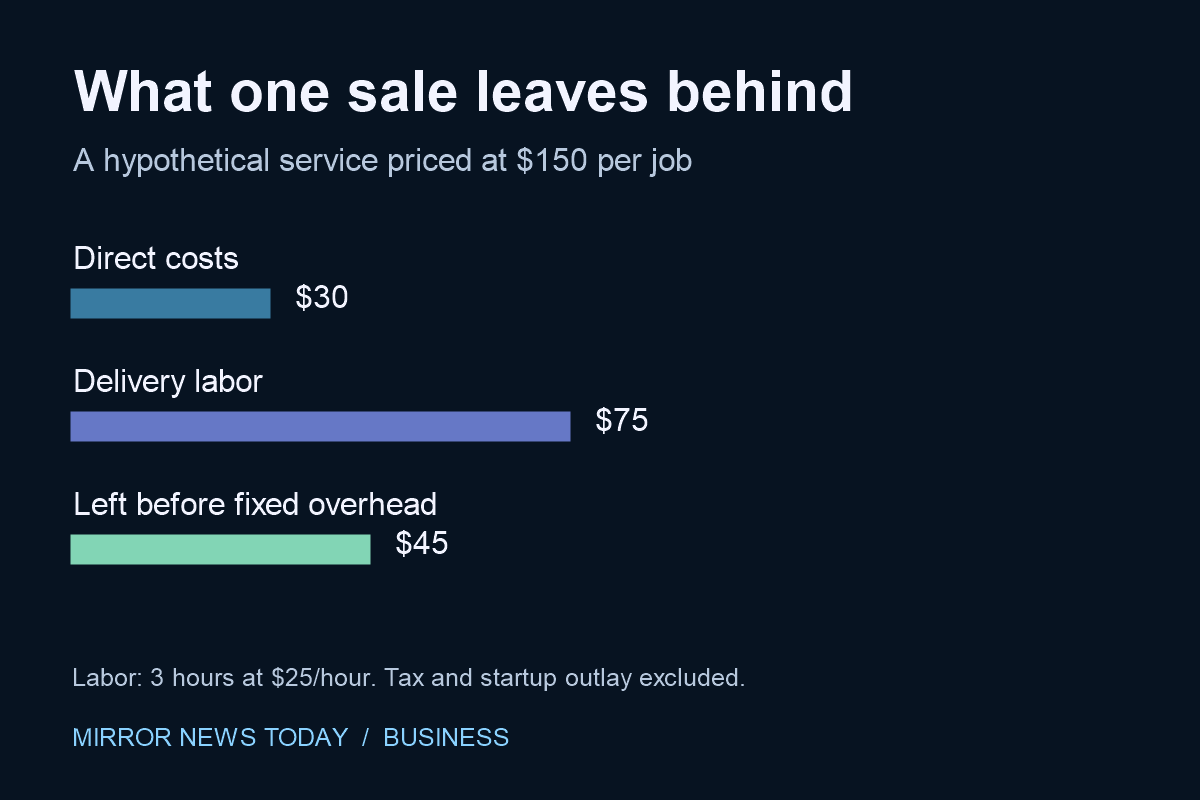
Consider a hypothetical service charging $150 per job. Assume $30 in direct costs and three hours of your time valued at $25 an hour. The job leaves $45 after those costs: $150 minus $30 minus $75. If monthly fixed expenses are $270, six comparable jobs cover that overhead. This simplified example includes an allowance for delivery labor, but excludes tax and recovery of one-time startup spending; it is not a forecast.
Now include the time spent finding customers and handling administration. If six jobs require 18 delivery hours and another 12 hours of unpaid sales work, your schedule must accommodate 30 hours. You may need to change the price, reduce the scope, or choose a different offer. Recalculate when your first completed job gives you better numbers.
The SBA expresses break-even units as fixed costs divided by price minus variable cost per unit. Keep the cost period consistent and be clear about how you count your labor. If the amount left per sale is zero or negative, additional sales will not cover fixed overhead under those assumptions.
Use AI suggestions to organize research
An idea tool can help you consider work you had overlooked or put your constraints into words. After using StartaBusiness.app to explore an initial fit, compare each candidate with a customer conversation and a cost estimate. Its guide to validating a business idea is a next reading step; your decision should depend on evidence from the market you intend to serve.
Ask any AI tool to list its assumptions. A suggestion to sell locally needs a plan for reaching local buyers. A proposal built around online sales needs a way to acquire customers at an affordable cost. Follow up on facts using original sources, and keep projected revenue separate from money someone has agreed to pay.
StartaBusiness.app discloses that it may earn commissions from tool links. Evaluate software and service recommendations as purchases in their own right. Check whether a tool is necessary for the pilot, what it costs after any introductory offer, and whether you can export your work if you leave.
Review the pilot before increasing the budget
At the review date, gather your notes, receipts, and customer feedback. Compare the price you expected with the price actually accepted. Compare estimated delivery time with the time recorded. Identify whether the customer received the outcome you promised and whether they would have a reason to buy again.
Continue when the evidence supports another affordable test. Revise the offer when buyers describe a useful problem but reject your scope or price. Pause when the work exceeds your capacity or the economics remain poor after realistic adjustments. Keep a written reason for the decision so a new idea does not erase what the experiment taught you.
What to consider
Choose one candidate, write a priced offer, and find the smallest responsible way to test it with a prospective customer. Increase spending only when completed work and recorded costs give you a reason to do so.
Common questions
How do I compare two ideas when both seem feasible?
Investigate the assumption that could rule each one out. If one depends on reaching buyers and the other depends on equipment costs, check those uncertainties first. Compare the evidence, time commitment, and affordable downside before choosing your next pilot.
Can I research an idea while keeping my current job?
Plan interviews and research around your existing obligations. Check your employment agreement for relevant restrictions, and keep employer time, information, and equipment separate from your project. A service that requires hours you cannot offer needs a different delivery plan.
What if interviews are positive but nobody buys?
Ask where the purchase stops. The buyer may lack budget, need approval, prefer an existing supplier, or misunderstand the offer. Change one part of the test at a time so you can tell whether the revision helped.
Do I need a full website for the first pilot?
Choose the simplest way for a customer to understand the offer and contact you. That may be a clear proposal or a small page. Establish any required operating permissions before delivery, and avoid spending on a large website before you know what buyers need to see.